Journal — On the body
Vitamin D, and what most of us are actually getting
Nicole Cassey
Founder, HeraVita
I have done early morning walks for years. Rows on the river before work. Time outside, daily, before most people are up. I assumed this was meaningful, that the sun on my skin in those hours was doing something. A few weeks ago I downloaded an app called DMinder, and what it told me was that almost none of it had counted. Pre-dawn light, low-angle morning sun — at the UV levels I was getting, my body wasn't synthesising vitamin D at all. This from a woman who has lived with a vitamin D deficiency, who has been osteopenic since she was thirty-six, who has a GP tracking her levels quarterly. I have been paying attention to this question for years. The numbers still surprised me. I am writing this because I think most women I know are in roughly the same position I was, without yet realising.
The gap between "a few minutes of sun" and what the body is actually doing
The standard line is that a few minutes of incidental sun is enough to maintain vitamin D. For a fair-skinned adult in the middle of a Brisbane or Perth summer, at midday, with arms and legs uncovered, that line is broadly true. The skin is efficient at this. Synthesis is fast.
Most of the year, for most women, none of those conditions are met.
Vitamin D synthesis happens when UVB radiation — a specific wavelength range — reaches uncovered skin at sufficient intensity. The intensity threshold matters. Below a UV index of around 3, synthesis effectively does not occur, regardless of how long you stand outside. UV index is a function of latitude, season, time of day, and cloud cover. ↗ ARPANSA, the Australian government agency responsible for radiation monitoring, publishes real-time UV readings for every capital city — it is the most accurate place to check what is actually happening in your sky right now.
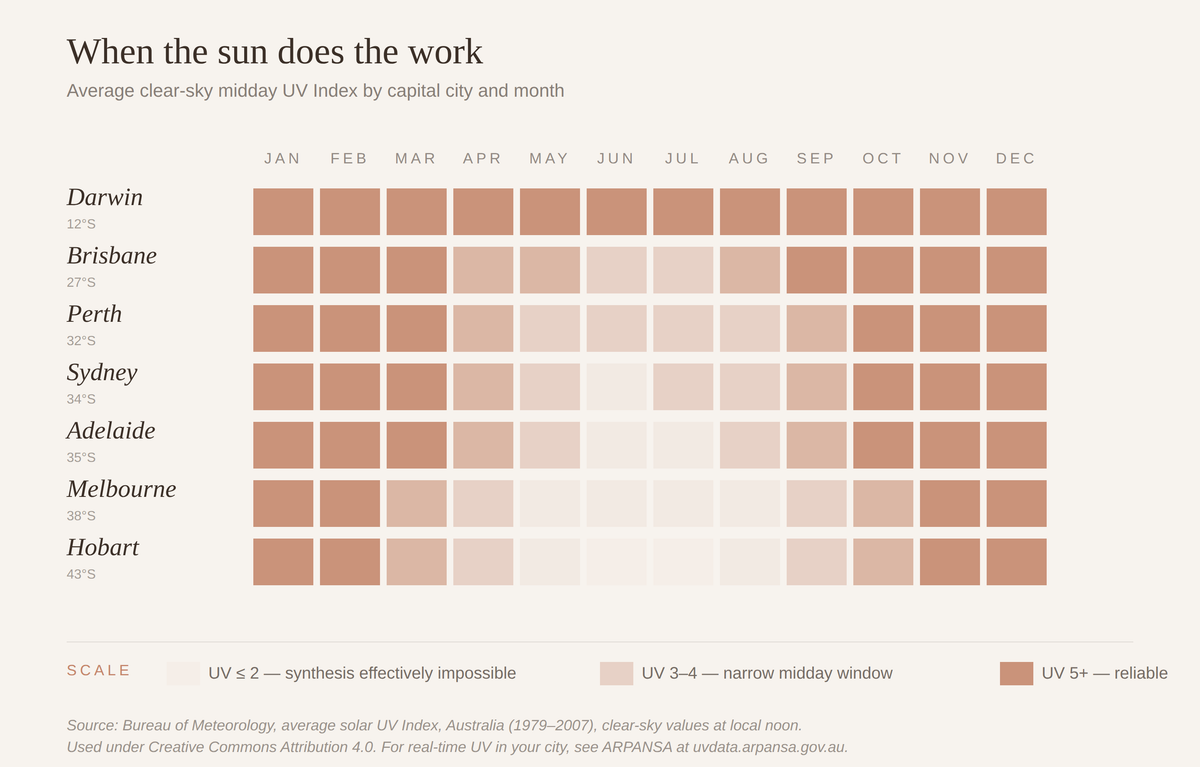
What the data shows: in Darwin and Brisbane, UV stays at or above the synthesis threshold for most of the year. In Sydney, Perth and Adelaide, the UV index drops below 3 for several hours either side of midday in winter, and below 3 for whole stretches of the day in early morning and late afternoon year-round. In Melbourne, it sits below 3 for most of the day across winter months. In Hobart, the UV index averages below 2 across June and July, which means synthesis is effectively impossible regardless of how long you stand outside.
What this means in practice: a woman in Melbourne who walks the dog at 7am in July, sits indoors until 5pm, and walks home at dusk is not synthesising vitamin D, regardless of how long she spent outside. The early walk feels like time in the sun. Biologically, it isn't. The photons that do the work were never there.
What DMinder actually shows you
DMinder is a small app that takes the variables — your latitude, the date, the time, the current UV index, your Fitzpatrick skin type, and how much skin is exposed — and produces a number: how long you would need to be outside, right now, to synthesise a meaningful amount of vitamin D.
The app is uncomfortable to use the first time, because the answer is often you cannot synthesise vitamin D right now, no matter how long you stand here. For most of the year, for most Australian women, for most hours of the day, that is the answer.
When synthesis is possible, it is usually possible for a narrower window than expected. In Sydney or Perth in May, viable synthesis happens roughly between 10am and 2pm. Outside those hours, your skin is being exposed to UVA — which contributes to skin ageing and damage — without the UVB needed to make the trade worth anything biologically.
This is not an argument against sun protection during peak UV hours. Sun protection during peak UV is sensible, and the evidence that sunscreen impairs vitamin D status in normal use is weak. It is an argument for noticing what your skin is actually doing in the time you spend outside, and whether any of that time is producing what you think it is producing.
Why this matters more than the messaging suggests
Vitamin D status intersects with several systems that become more salient from the mid-forties onward — though, as I have written about in The story behind HeraVita, some of these conversations should have started for me much earlier than they did, and would have, in a system better calibrated to women's bodies.
The skin's capacity to synthesise vitamin D declines with age. By some estimates, a 70-year-old produces around a quarter of what a 20-year-old would from the same exposure. The decline begins earlier and is steeper than most people assume. By 50, synthesis efficiency is already meaningfully reduced.
At the same time, the demand on vitamin D-dependent systems goes up. Bone density loss accelerates around menopause, though bone density is a lifetime concern, not only a post-menopausal one — the architecture is laid down decades earlier than most women think. Adequate vitamin D is part of the calcium absorption pathway that maintains it. Muscle function, particularly in the lower body, appears to be vitamin D sensitive, with implications for falls and fracture risk over time. Immune regulation, which involves vitamin D as a signalling molecule, is also worth taking seriously through a transition that already places stress on it.
I have a personal stake in this section. I was diagnosed osteopenic at 36, at a point when no conversation about menopause was relevant. My mother has osteoporosis. Both of my grandmothers had it. The cause, in my case, was not one thing — there is a clear familial pattern, alongside other contributors I have spent years working out. Vitamin D is part of that picture. It is not all of it. Oestrogen decline does most of the work in midlife bone loss, and the genetic loading does much of the rest. But vitamin D is one of the inputs I can see and act on, which is why I treat it as seriously as I do.
There is a system-level point worth naming here. Medicare in Australia rebates DEXA scans for general screening only from age 70. A woman in her forties or fifties, without a qualifying condition, will generally not have had one by which point, as I have written elsewhere, the window for meaningful intervention has often closed. The systems we rely on to flag a problem are calibrated to flag it late. Vitamin D is one of the few inputs into the bone density picture a woman can pay attention to without waiting to qualify. The serum 25(OH)D test is widely available, costs little, and tells you where you are.
If you take one thing from this
A serum 25(OH)D test is the only way to know your actual status. It is a standard blood test that can be ordered through your GP. Most women have never had one. It is the first useful piece of information in this conversation.
What the current Australian guidance actually says
The Australian position statement on sun exposure was revised in 2024, with the consensus document led by researchers at QIMR Berghofer and the University of Queensland following a national Sun Exposure Summit. It was endorsed by a wide range of organisations — including the Royal Australian College of General Practitioners, the Australasian College of Dermatologists, the Australian and New Zealand Bone and Mineral Society, the Endocrine Society of Australia, Healthy Bones Australia (formerly Osteoporosis Australia), Multiple Sclerosis Australia, the Australian Skin and Skin Cancer Research Centre, Melanoma Patients Australia, and Cancer Council Australia.
That list is worth pausing on. The Royal Australian College of GPs represents the doctors who actually see women navigating perimenopause and bone density loss. The Australasian College of Dermatologists are the specialists in skin and skin cancer. The Bone and Mineral Society and Healthy Bones Australia treat osteoporosis and osteopenia. The Endocrine Society treats hormonal and metabolic conditions. Multiple Sclerosis Australia advocates for a population in whom vitamin D status is genuinely consequential. These bodies endorsed the consensus document as written.
Cancer Council Australia also endorsed the document, though it requested changes to the wording before doing so. Their public-facing communications continue to use a more cautious version of the same advice. This is worth knowing — not because Cancer Council is wrong, but because the bodies are answering different questions. The clinicians on the other endorsing committees were considering the trade-offs for the individual patients they treat — many of whom are already losing bone density, already vitamin D insufficient, already navigating the consequences. Cancer Council's mandate is population-level prevention of skin cancer, and at population scale, the calculation looks different. Both frames are reasonable. What matters is recognising which question is being answered, by whom, on which day.
The consensus document explicitly recognises that sun exposure has health benefits beyond vitamin D, and that the balance of risks and benefits is not the same for everyone. It separates the population into three risk categories, with different recommendations for each. For most fair-to-olive skinned Australian women, the position is that sun protection remains a priority during peak UV — and that incidental outdoor time outside of those hours is generally sufficient for vitamin D maintenance.
What the statement does not say, and what is sometimes assumed, is that the sun is a hazard to be avoided. The earlier framing has shifted. The current position acknowledges that sunlight does several things in the body, and that the calculation is individual.
The other thing worth knowing: in southern Australia in late autumn and winter, when the UV Index falls below 3, both the consensus statement and Cancer Council's own guidance say that time outdoors in the middle of the day with some skin uncovered is appropriate for vitamin D. This is the official position, not a fringe one. It is rarely communicated.
A more attentive relationship with the sun
The point of this post is not a prescription. It is attention.
Most women have not looked at when synthesis is actually happening for them. Most have not had a serum 25(OH)D test. Most have not noticed the gap between the few minutes of incidental sun the public messaging refers to and the conditions under which those few minutes do anything.
Once you look, the question changes. It is no longer "am I getting enough sun?" - a vague question with a vague answer. It becomes "is the sun I am getting at a UV index that triggers synthesis, on enough skin, for long enough, given my age and skin type?" That question has an answer. The answer is often no.
What you do with the answer is yours. For some women it will mean moving the same outdoor time from before work to lunchtime — the same ten minutes, in different photons. For some it will mean a conversation with a GP about supplementation. For some it will mean noticing, for the first time, that they have constructed a life that is almost entirely indoors, and deciding whether that was on purpose.
The body did the work of evolving the synthesis pathway. It is worth giving it the conditions to use it.
This article is for general information and is not medical advice. Vitamin D status, sun exposure, and supplementation should be discussed with a qualified healthcare practitioner — particularly for women with personal or family history of skin cancer, immunosuppression, autoimmune conditions, or other health considerations. The research on vitamin D and health outcomes continues to evolve, and the relationship between sun exposure and skin cancer risk is real and well-established. The intent of this post is to encourage informed attention, not to advise against sun protection.
References
- ARPANSA. Real-time UV Index for Australian capital cities. Australian Radiation Protection and Nuclear Safety Agency. uvdata.arpansa.gov.au
- Bureau of Meteorology. Average solar UV Index, Australia (1979–2007). bom.gov.au/climate/maps/averages/uv-index. Used under CC BY 4.0.
- Holick MF. Vitamin D Deficiency. New England Journal of Medicine, 2007. DOI: 10.1056/NEJMra070553
- Neale RE et al. Balancing the risks and benefits of sun exposure: A revised position statement for Australian adults. Australian and New Zealand Journal of Public Health, 2024. DOI: 10.1016/j.anzjph.2023.100117
- Webb AR, Kift R, Berry JL, Rhodes LE. The vitamin D debate: translating controlled experiments into reality for human sun exposure times. Photochemistry and Photobiology, 2011.
- Cancer Council Australia. Vitamin D and sun protection. cancer.org.au/cancer-information/causes-and-prevention/sun-safety/vitamin-d
Leave a comment
Add a comment